Choosing the wrong size rope is one of the most common — and most easily overlooked — mistakes in boat ownership. Too thin and your mooring line can’t handle a strong wind or surge from a passing vessel. Too thick and it won’t fit your cleats properly, is harder to work with, and costs more than it needs to. Get it right and your boat sits quietly in its berth, whatever the weather throws at it.
This guide covers both mooring lines and fender lines: what diameters to choose, what lengths you’ll need, and the key variables most guides ignore. Whether you’re on a 22ft day cruiser or a 50ft blue-water yacht, the same principles apply.
Quick answer: For most boats, mooring line diameter should be approximately 1mm per foot of boat length. Fender lines are typically 8–12mm diameter and 1.5–2.5m long for most leisure craft.
Part 1: Mooring Line Size Guide
Choosing the Right Diameter
Diameter is the most critical dimension for mooring lines. It determines breaking load, how well the rope fits your cleats and fairleads, and how comfortable it is to handle under load.
The most reliable starting point is your boat’s length overall (LOA). As a general rule, allow 1mm of diameter for every foot of boat length, then round to the nearest standard size. A 30ft boat needs roughly 10mm; a 40ft boat needs 12–14mm. Use the table below to find your size:
These ranges overlap deliberately — a 35ft boat in a sheltered marina is a different proposition to the same boat moored in an exposed tidal harbour. Use the lower end for sheltered conditions and lighter displacement; step up a size if any of the following apply:
- Your boat is heavy for its length (full-keel cruising yacht, flybridge motorboat)
- You moor in an exposed or tidal location
- You leave the boat unattended for extended periods
- Your marina experiences significant wash from commercial traffic
Choosing the Right Length
Most boats need at least four mooring lines: a bow line, a stern line, and two spring lines. Each has different length requirements.
| Line Type |
Recommended Length |
Purpose |
| Bow line |
Equal to boat LOA |
Holds the bow to the pontoon or cleat |
| Stern line |
Equal to boat LOA |
Holds the stern securely in place |
| Forward spring |
1.5× boat LOA |
Prevents the boat surging forward |
| Aft spring |
1.5× boat LOA |
Prevents the boat surging aft |
Aqua Marine mooring lines are stocked in 8m and 10m lengths for most diameters, with 15m available in 14mm and 16mm. An 8m line suits bow and stern lines for boats up to around 28ft. For spring lines or longer berths, 10–15m is generally more practical.
Why Spliced Eyes Matter
All Aqua Marine mooring lines come with a professionally spliced eye at one end. A well-made splice retains up to 95% of the rope’s original breaking strength. A knot — even a well-tied bowline — can reduce that by 30–50%. For a line that may be holding your boat in storm conditions, that difference is significant. A spliced eye also makes securing to a bollard or pontoon ring faster and more reliable.
Tip: Always carry at least one or two spare lines. A spare stern line costs little and has saved many boats in unexpected situations — arriving at a lock, rafting up overnight, or dealing with a failed line in poor weather.
Part 2: Fender Line Size Guide
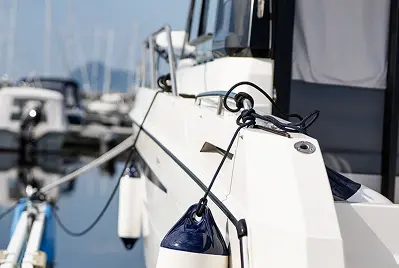
Fender lines have a different job to mooring lines — they hold each individual fender at the correct height against the hull rather than taking the full load of the boat. But choosing the wrong size still causes real problems. A line that’s too thin is difficult to tie and chafes through quickly. One that’s too short leaves the fender in the wrong position. Too long and the fender hangs too far from the hull or dips below the waterline.
Fender Line Diameter
The key constraint for diameter is the size of the fender’s rope eye. The line needs to thread through cleanly and leave enough room to tie a secure knot. For the vast majority of leisure fenders — Polyform F-Series, G-Series, and similar cylindrical types — the rope hole is designed for 8–12mm line.
If you’re unsure, check the fender manufacturer’s rope hole diameter and choose a line 1–2mm smaller than the maximum stated — this leaves enough room to tie securely without the line jamming in the eye.
Fender Line Length
Length is where most people go wrong, usually by buying lines that are too short. The correct length depends on your attachment point: a lifeline or guardrail, a cleat, or a stanchion base.
| Attachment Point |
Recommended Length |
Notes |
| Lifeline or thin guardrail |
1 – 1.5m |
Most common method; allows easy height adjustment |
| Cleat or stanchion base |
2 – 2.5m |
Extra length needed to loop around the fitting |
| Larger vessel (35ft+) |
2.5 – 3m |
Greater freeboard means more line between rail and waterline |
Practical check: Hold one end at the attachment point and let the rest hang to where the fender needs to sit. Add 30–40cm for the knot and adjustment — that’s your working length. If in doubt, go longer; you can always take up slack with the knot.
Why Double Braid Polyester?
All Aqua Marine lines — both mooring and fender — use double braid polyester construction. A braided core sits inside a braided cover: the core carries the load; the cover protects against UV, abrasion, and chafe. This gives the rope its combination of high strength, low stretch, soft handling, and long service life.
| Property |
Double Braid Polyester |
Three-Strand Polyester |
Nylon |
| Strength |
High |
Moderate |
High |
| Stretch |
Low |
Low–Moderate |
High |
| UV Resistance |
Excellent |
Good |
Moderate |
| Handling |
Very good — soft, no kinking |
Fair — tends to kink |
Good |
| Durability |
Excellent |
Good |
Moderate |
Three-strand polyester is cheaper, but it kinks, is harder to splice, and doesn’t handle as well under load. Nylon’s high stretch makes it useful as a shock absorber in some applications, but for marina mooring it means your boat moves more in its berth. For everyday UK mooring and fender use, double braid polyester is the right call.
Quick Reference Summary
| Boat Length |
Mooring Diameter |
Mooring Length |
Fender Line Dia. |
Fender Line Length |
| Up to 22ft |
8mm |
6 – 8m |
8mm |
1 – 1.5m |
| 20 – 35ft |
10mm |
8 – 10m |
8 – 10mm |
1.5 – 2m |
| 30 – 45ft |
12 – 14mm |
10m |
10 – 12mm |
2 – 2.5m |
| 40 – 55ft |
14 – 16mm |
10 – 15m |
12mm |
2.5 – 3m |
| 55ft+ |
16mm+ |
15m+ |
12mm+ |
3m+ |
Frequently Asked Questions
What size mooring line do I need for a 30ft boat?
A 30ft boat sits in the overlap between 10mm and 12mm. Use 10mm for a lighter boat in a sheltered marina berth. Step up to 12mm for heavier displacement or more exposed conditions. Bow and stern lines should be around 8m; spring lines 10m or longer.
What size mooring line do I need for a 40ft boat?
A 40ft boat needs 12–14mm mooring lines. Choose 12mm for a lighter boat in a calm berth; go to 14mm for heavier displacement or exposed positions. Line length should be 10m for bow and stern lines, with 10–15m for spring lines depending on your berth arrangement.
What diameter fender line do I need?
For most leisure boats, 8–12mm covers the full range. Small fenders on dinghies and RIBs work with 6–8mm. Mid-size fenders on 20–35ft boats suit 8–10mm. Larger fenders on 35ft+ boats typically need 10–12mm. Always check the line fits through your fender’s rope eye without forcing.
How long should fender lines be?
For attachment to lifelines or guardrails, 1–2m is usually enough. If you’re tying to cleats or stanchion bases, allow 2–2.5m. Larger boats with more freeboard may need 2.5–3m. Err on the longer side — you can always take up slack with the knot.
Is double braid rope better than three-strand for mooring?
Yes, for most leisure boating. Double braid polyester is stronger for a given diameter, doesn’t kink, handles better under load, and holds a splice well. Three-strand is cheaper, but for lines responsible for securing your boat, the upgrade is worth it.
How many mooring lines does my boat need?
At minimum, four: one bow line, one stern line, and two spring lines (forward and aft). Most experienced owners carry six or more, including spares for visiting berths, lock passages, or rafting alongside other boats.
How often should mooring lines be replaced?
Inspect lines at least once a season. Replace them if you notice significant UV bleaching, stiffness, visible chafe or fraying, or any reduction in flexibility. Quality double braid polyester used in normal conditions typically lasts three to five seasons, but lines left permanently on a pontoon may need attention sooner.
Should I go up a size for an exposed mooring?
Yes. Exposed moorings — outer harbour walls, tidal berths with significant range, marinas with heavy commercial traffic — put more dynamic load on your lines. Sizing up one step (e.g., 10mm to 12mm) gives meaningful extra strength for relatively little extra cost.
All Aqua Marine mooring and fender lines are available at Boat Fenders Direct with next-day UK delivery. View the full range of mooring lines and fender lines.